About
Regional Partners
The Fall Line is a truly collaborative effort, powered by a diverse group of regional partners working together to bring the trail to life.
The Fall Line is a truly collaborative effort, powered by a diverse group of regional partners working together to bring the trail to life. Spanning 43 miles and connecting seven Central Virginia communities—from Ashland to Petersburg—the project is guided by local governments, regional planning organizations, transportation agencies, and nonprofit partners.
Together, these 14 entities play a vital role in planning, building, and supporting the trail, ensuring it serves as a lasting asset for the entire region.
This section highlights the key partners helping guide the trail’s planning, funding, and implementation—including PlanRVA, Crater Planning District Commission, the Central Virginia Transportation Authority, and the Virginia Department of Transportation.
CVTA
The Central Virginia Transportation Authority provides funding for transportation projects within Central Virginia. The Fall Line trail was chosen as the first project to receive regional funding from the Authority. The Authority has created a special Fall Line Work Group to facilitate funding of the Fall Line trail from available transportation sources.
PlanRVA
PlanRVA is an organization comprising nine local governments for the purpose of encouraging collaboration to address regionally significant issues and opportunities. They have been instrumental in facilitating the Fall Line as a part of the regional transportation network. They continuously plan for the future transportation needs for the central Virginia region and embrace all forms of transportation including the usage of trails.
Crater Planning District Commission
Crater Planning District Commission is an organization comprising of local governments for the purpose of encouraging collaboration to address regionally significant issues and opportunities. The Fall Line trail passes through the northern part of their district in southern Chesterfield, Colonial Heights, and Petersburg. They have been instrumental in facilitating the Fall Line as a part of the regional transportation network in the region. They continuously plan for the future transportation needs of the region including walking and biking.
VDOT
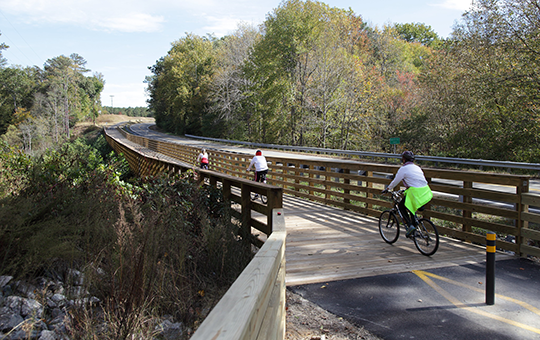
The Virginia Department of Transportation is the primary funder of construction and maintenance for state highways, roads, trails, and sidewalks. VDOT has played a pivotal role in the creation, funding and construction of the Fall Line trail. They completed a corridor study in February, 2020 that vetted the feasibility of the trail and determined the best alignment to meet regional transportation and environmental needs. VDOT has provided funding for the construction of the trail through a number of transportation funding mechanisms. VDOT is also managing the construction of the northern and southern most sections of the Fall Line.
Over multiple years of planning and preliminary engineering, VDOT has shown a commitment to building the Fall Line trail and working with communities along the corridor to refine the alignment due to acute constraints (e.g., cultural artifacts). VDOT’s standard for the Fall Line is a 10-foot wide off-road asphalt path. The investment in a regional trail by a state department of transportation is momentous. Regional leaders and advocates understand that by investing in the Fall Line trail alongside VDOT, the magnitude of the trail’s potential impact on the region grows astronomically.
The way communities, private developers, and non-governmental agencies add their own investment on top of the funds VDOT has committed will likely look different along the corridor. The following section sets the shared vision for a baseline experience of the Fall Line trail that goes above and beyond the VDOT plan to create a world-class regional trail.